Login
Sign Up
Homepage
Games
News
News ▾
All
Transfers
Drama
Business
Sponsors
Mergers
Investors
Hires
Companies
More News
People
Tournaments
Brands
Brands ▾
Companies
Organizations
Sponsors
Other
Locations
Search
Login
Sign Up
Read
Source Editing
Visual Editing
Editing
News/Hideki Sato Passed Away
From TwogPedia
News/Hideki Sato Passed Away
Warning:
You are not logged in. Your IP address will be publicly visible if you make any edits. If you
log in
or
create an account
, your edits will be attributed to your username, along with other benefits.
Anti-spam check. Do
not
fill this in!
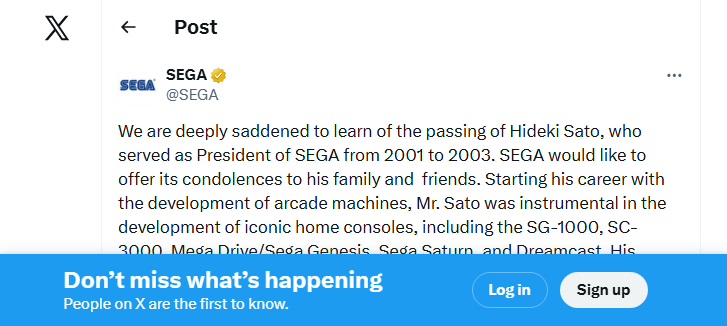
{{News |seo_title=Hideki Sato Passed Away |seo_keywords=Sato |image=SEGA.jpg |tags=Sega |date=2026-02-16T12:24:15.000Z |sources={{NewsSource |source=Twitter |url=https://x.com/SEGA/status/2023331707282186711 |article=News/Hideki Sato Passed Away }} |author=Andura |category=Drama |content=Hideki Sato, the longtime Sega engineer who helped shape the company’s most iconic arcade and home console hardware, has passed away. Japanese games outlet Beep21 reported that Sato died this weekend. He was 78. Sato joined Sega in 1971 and went on to become one of the most influential figures in the company’s history. Over several decades, he led the research and development teams responsible for creating Sega’s arcade systems and home consoles, including the Master System, Genesis or Mega Drive, Saturn, and Dreamcast. He also served as Sega’s acting president from 2001 to 2003 before leaving the company in 2008. For many fans, Sato’s legacy is inseparable from Sega’s rise during the golden age of video games. ==== From Arcades to the Living Room ==== Sato often spoke about how Sega’s identity was rooted in its arcade business. That influence carried directly into its home console designs. “From the beginning, Sega’s home console development has always been influenced by our arcade development,” Sato previously told Famitsu in an interview reflecting on the company’s history. “Our first 8-bit machine was the SC-3000. This was a PC for beginner-level users. At that time, Sega only did arcade games, so this was our first challenge. We had no idea how many units we’d sell.” The SC-3000 marked Sega’s first serious step into the consumer market. It was a learning experience for a company that, until then, had focused almost entirely on arcade cabinets. That early risk laid the groundwork for what would become some of the most memorable consoles in gaming history. ==== The Mega Drive and the 16-Bit Leap ==== [[Companies/Sega|Sega]]’s biggest commercial success came with the Mega Drive, known as the Genesis in North America. Under Sato’s leadership, Sega leaned heavily on its arcade expertise to gain a technological edge. “At that point, we decided to start developing a new home console. By then, arcade games were using 16-bit CPUs,” Sato said. “Arcade development was something we were very invested in, so we were always using the most cutting-edge technology there. Naturally, it started us thinking: what if we used that technology in a home console? “Two years after we started development, it was done: a 16-bit CPU home console, the Megadrive. The 68000 chip had also recently come down in price, so the timing was right.” The decision to use the Motorola 68000 processor gave the Mega Drive power that helped it compete aggressively in the 16-bit era. It became Sega’s most successful home console and a defining platform of the early 1990s. ==== Dreamcast and the End of an Era ==== Sato also played a central role in the creation of the Dreamcast, Sega’s final home console. Though it ultimately marked the end of Sega’s hardware business, the Dreamcast remains beloved for its innovation and ambition. On Dreamcast, the release that ultimately ended Sega’s run in hardware, Sato said the keyword for the development was “play and communication.” “The ultimate form of communication is a direct connection with another, and we included the modem and the linkable VMUs for that purpose,” he said. “We had also planned to have some sort of linking function with cell phones, but we weren’t able to realize it. Consumers were now used to the raging ‘bit wars’, so even though we knew it was a lot of nonsense, we needed to appeal to them in those terms with the Dreamcast.” '''More:'''[[News/Naphat “Tokyogurl” Warasin and Cheerio Arrested for Cheating|Naphat “Tokyogurl” Warasin and Cheerio Arrested for Cheating]] }}
Summary:
Please note that all contributions to TwogPedia may be edited, altered, or removed by other contributors. If you do not want your writing to be edited mercilessly, then do not submit it here.
You are also promising us that you wrote this yourself, or copied it from a public domain or similar free resource (see
TwogPedia:Copyrights
for details).
Do not submit copyrighted work without permission!
Cancel
Editing help
(opens in new window)
Pages included on this page:
Template:News
(
edit
)
Template:NewsArticle.css
(
edit
)
Template:NewsNav
(
edit
)
Template:NewsSource
(
edit
)
Template:RelatedNews
(
edit
)
Module:Arguments
(
edit
)
Module:NewsSource
(
edit
)
Module:RelatedNews
(
edit
)
Module:SocialShare
(
edit
)
Module:TruncDesc
(
edit
)
Media Archive:
No categories